
Don't Delegate Understanding!
By: Jesse Jones
AI and Legal Services: A Business Owner’s Guide
In just a few years, generative AI tools like ChatGPT (let’s call our AI friends, collectively, “Jen A.I.”) have gone from novelty to near necessity - a tool some people would feel genuinely lost without. This isn’t a criticism (and this article isn’t going to talk about other laws around AI - see here if you’re interested in that angle). As a business owner and attorney, I increasingly rely on these tools myself.
This is our new reality. So, how Jen A.I. can serve as an effective partner? In what scenarios can it help us express ideas clearly or find a starting point for complex questions? Where does Jen A.I. dull creativity or flatten the nuance required for complicated subjects? At last year’s Business of Software Conference, one of the speakers (Gia Laudi) made a point that I haven’t been able to get out of my head since: you can delegate many things to AI, but we can not, must not, delegate understanding. That is so true.
Which brings us back to the point of this article: As a business owner, you should be delegating responsibility for your company’s legal needs, but should you use Jen A.I. to solve your legal issues instead of hiring an actual lawyer?
As you may have guessed, the answer is: it depends.
Jen A.I.’s strengths lie in its ability to process vast amounts of information, synthesize it, and present it in a way that’s understandable to humans. But here’s the catch: there is no tool out there that can independently evaluate your situation or confirm that its answers reflect current, jurisdiction-specific law. Jen A.I. generates responses based on patterns learned during training, not on an understanding of your business, your goals, or your risk tolerance.
There’s an old saying in technology and the data world: garbage in, garbage out. If the information going into the system is flawed, incomplete, or poorly framed, the output will be too. But the risk is not just that an answer might be wrong, it’s that it might sound right, and you won’t necessarily know the difference. If you don’t have the background to spot the issue (i.e. if you’ve fallen prey to the delegation of understanding), every confident answer can feel equally reliable.
For lawyers, this means Jen A.I. can be a useful tool if we proceed with caution. Every attorney still has a professional duty to verify accuracy, protect confidentiality, and apply independent judgment before relying on any output produced by technology. Those ethical obligations don’t disappear just because the draft came from a very convincing robot. While clients may not always have visibility into how AI tools are used, lawyers remain fully accountable for their work product regardless of whether AI assisted in its preparation.
Where AI Falls Short in Legal Work
As for business owners hoping to bypass the cost of legal counsel by way of Jen A.I., it would be wise to tread carefully.
Here are a couple of examples in which the person might consider turning to Jen A.I.
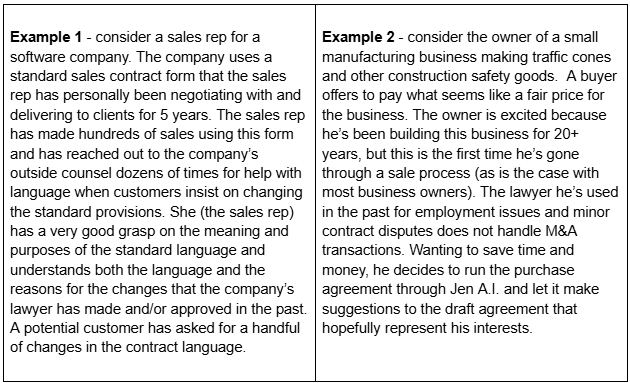
Hopefully it is pretty obvious that Example 2 is not a good idea. But what about Example 1? It seems like the sales rep has a very good understanding of the document that she uses on an almost daily basis. And it seems like she understands why the company attorney has been willing to make changes to the standard language. That is a good start because the sales rep has a much better chance of spotting changes that are close but not quite right.
At this point a lot comes down to what the company’s leadership decides regarding business risk. Are these short term contracts that either party can get out of relatively easily? Or are they multi-year commitments that will be the basis for the value of the company when it comes time to sell? Is it the cost of outside counsel or the speed at which the company’s lawyer moves that is enticing the company to skip the lawyer and use Jen A.I.? Is there a different way to fix that issue?
A Smarter Approach: AI as Assistant, Not Replacement
Jen A.I. is capable of synthesizing large amounts of information into coherent explanations that can point you in the right direction. Returning to Example 2, imagine you receive a letter of intent and a draft agreement, and some of the language feels impenetrable. Rather than relying on AI to make decisions for you, you retain an M&A lawyer but use Jen A.I. to help you understand general concepts, organize your thoughts, and communicate your questions to your M&A lawyer more efficiently.
In that context, Jen A.I. can be genuinely helpful. You streamlined the process, but have the comfort that a professional has considered your specific situation when reviewing those agreements, and that he or she will have to answer for any issue that arises after the deal closes.
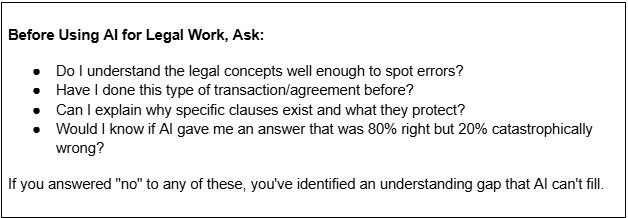
There are other reasons business owners should think carefully about DIY’ing their legal services with Jen A.I., but for now I am giving Jen A.I. the last word. This was my actual prompt into ChatGPT:

Here is the unedited answer, verbatim:
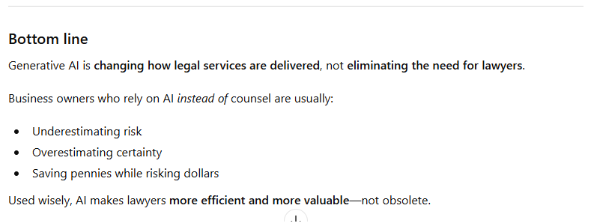
So yes, Jen A.I. can be helpful in a legal context - in most cases when used by an experienced lawyer. But it can’t replace judgment, experience, or the accountability that comes with professional legal advice.
You can’t delegate understanding.
Common Questions About Using AI for Legal Services
-
A: AI can help you understand concepts and organize questions, but it can't evaluate your specific situation or confirm current, jurisdiction-specific law. It works best alongside a lawyer, not as a replacement for one.
-
A: Yes, AI answers can sound confident and correct even when they're wrong, and if you lack legal background, it's hard to catch the difference. The saying "garbage in, garbage out" applies: flawed input leads to flawed output.
-
A: Yes, lawyers remain fully accountable for their work product whether or not AI assisted in preparing it. They still must verify accuracy, protect confidentiality, and apply independent judgment before relying on any AI output.
-
A: Use AI to help you understand general concepts and prepare clear questions, then bring those questions to a licensed attorney. This way you save time while still getting professional judgment on your specific situation.
About Fourscore Business Law
Whether you're launching a startup, raising capital, or navigating M&A, our experienced team provides strategic, world-class legal counsel that supports your vision and enables confident decision-making at every stage of growth. Fourscore Business Law empowers forward-thinking entrepreneurs and business leaders by simplifying complex legal transactions. With a focus on efficiency and personalized service, we help you overcome legal challenges so you can focus on innovation and scaling your business. Ready to secure your startup's future? Take our free legal assessment for founders today to better understand your company’s legal health.
Picture on the top is by Vitaly Gariev and is in the public domain.